

Co-Founder, Head – QA/RA

Introduction to ISO 13485
If you build, design, deploy or sell anything that touches human health, you live under one universal truth. Quality is not optional. In MedTech, Biotech and HealthTech, a single weak control can crash your entire business faster than a glitch in a pacemaker test.
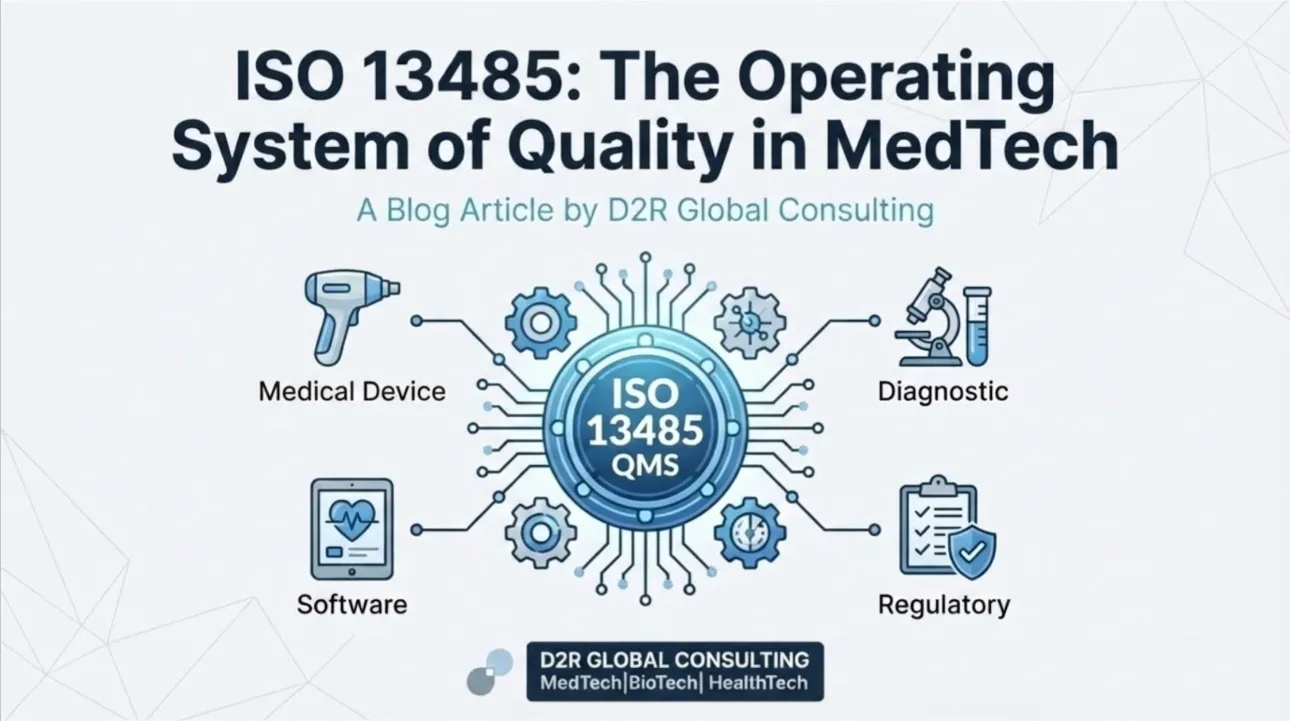
That is why ISO 13485 has become the backbone of global medical device quality systems. It has more influence over the MedTech world than half the VCs funding it. Companies that understand it scale. Companies that don’t spend their time apologizing to auditors.
This article goes deep into ISO 13485 certification through the lens of today’s industry. Hardware MedTech. Software SaMD. Biotech platforms. AI-driven HealthTech. It covers how the standard impacts design, manufacturing, clinical claims, regulatory pathways and commercial growth.
1. What ISO 13485 Actually Does
ISO 13485 is a Quality Management System (QMS) standard for medical devices and related services. It aligns with global regulations like:
ISO 13485 gives you a structure that forces you to do three things consistently:
1.
Prove what you built is safe.
2.
Prove you can build it repeatedly.
3.
Prove you will fix issues before someone else finds them.
If you think this sounds boring, think again. In reality, it is market access insurance.
Sources:
- ISO. (2016). ISO 13485 Medical devices. Quality management systems. Requirements for regulatory purposes.
- FDA. (2022). Proposed rule to harmonize Part 820 with ISO 13485.
2. Why It Matters in Today’s MedTech Landscape
2.1 The industry is evolving faster than regulators
Traditional MedTech was built around hardware like ECG machines or imaging systems. Biotech now blends device plus therapy. HealthTech and SaMD bring cloud platforms, AI, ML and mobile apps into the regulated world.
ISO 13485 remains the one structure that ties these domains together. It is flexible enough for:
- A company manufacturing cardiac monitors.
- A startup building a risk scoring algorithm.
- A cloud-based diagnostics platform.
- A biotech team integrating assay kits with software.
This flexibility is intentional. The standard was designed to work even for tech that didn’t exist in 2016.
2.2 Investors quietly care more than founders think
If you ever pitch to serious life science investors, their first two questions are predictable.
- “What is your regulatory pathway?”
- “Do you comply with ISO 13485 or plan to?”
Because they know the truth. A product without a QMS is just a **prototype**. And prototypes don’t enter markets. Or generate revenue.
2.3 Quality is now a competitive advantage
The fastest growing MedTech companies use ISO 13485 to:
- Shorten design cycles
- Reduce rework
- Strengthen clinical claims
- Accelerate technical file creation
- Get MDR approvals faster
- Make due diligence painless
Having a mature QMS lets you scale product lines without chaos. Ignore it and your future self will spend all day replying to audit nonconformities instead of shipping new features.
3. Key Clauses of ISO 13485:2016 Explained for Today’s Industry
Let’s break down the clauses in a way founders and executives actually use them.
3.1 Clause 4: Quality Management System
This is the backbone. Policies. Processes. Documentation. For HealthTech companies transitioning from software culture, this is often the biggest shock. Engineering teams cannot rely on tribal knowledge or “we fixed it on GitHub”.
Source: AAMI. (2021). Medical device software quality system considerations.
3.2 Clause 5: Management Responsibility
Leadership must show:
- Commitment
- Resource allocation
- Internal communication
- Customer focus
In simple terms, this clause prevents teams from blaming “lack of support from management” when issues occur. In Biotech, this includes oversight over assay validation and product claims. In HealthTech, it ties management to cybersecurity and uptime monitoring.
3.3 Clause 6: Resource Management
People. Training. Infrastructure. Environment.
- MedTech companies often fail audits because training files look like last minute homework assignments sent five minutes before class.
- Biotech teams must monitor environmental conditions for lab accuracy.
- Cloud HealthTech systems must prove server resilience and data backups.
3.4 Clause 7: Product Realization
This is the largest and most important section.
- Design and development
- Supplier controls
- Risk management
- Software validation
- Manufacturing
- Sterilization (when relevant)
- Traceability
- Clinical evaluation linkage
If Clause 4 is the operating system, Clause 7 is the apps running on it.
For SaMD and AI HealthTech
This is where the action really is:
- Algorithm change management
- Data training traceability
- Verification and validation of models
- Human factors analysis
- Cybersecurity
- Cloud architecture controls
For Biotech
Clause 7 controls the entire journey from raw material sourcing to wet lab reproducibility and kit performance.
Sources: IEC 62304:2006. Medical device software lifecycle processes. IMDRF. (2017). Software as a Medical Device. Clinical Evaluation.
3.5 Clause 8: Measurement, Analysis and Improvement
Auditors love this clause because it tells them whether your company knows its own problems. This includes:
- Post market surveillance
- CAPA
- Complaint handling
- Internal audits
- Trend analysis
- Risk reassessment
For HealthTech companies, this extends to uptime reports, incident logs, cybersecurity events and version-tracking.
4. ISO 13485 for Different Industry Segments
4.1 MedTech Hardware
Examples: ECG devices, ventilators, monitors, imaging accessories.
Key focus areas
- Design controls
- Electrical safety testing (IEC 60601)
- Biocompatibility (ISO 10993)
- Calibration and maintenance
- Traceability of components
- Field safety corrective action processes
When MedTech companies skip proper QMS controls, recalls increase fast.
A study of FDA recalls (Lam et al., 2018) showed that 70 percent of major device recalls were due to design issues traced back to weak design controls.
Source: Lam, C et al. (2018). Medical device recalls and the role of design. Journal of Biomedical Engineering.
4.2 Biotech and Diagnostics
Examples: IVD kits, molecular diagnostics, point of care systems.
QMS priorities
- Assay validation
- Stability studies
- Sensitivity and specificity documentation
- Reagent lot traceability
- Transport and storage conditions
- CE-IVDR expectations
ISO 13485 works closely with ISO 14971 (Risk Management) and ISO 15189 (Clinical Labs) here. During COVID-19, we saw the chaos caused by rushed kits with weak QMS documentation. Countries had to pull entire batches off shelves. Companies with ISO 13485 sailed through procurement far faster because their data was trustworthy.
Source: Wilson, M. (2020). IVD regulation and quality failures during the pandemic. Clinical Lab Review.
4.3 HealthTech, SaMD and AI/ML Platforms
This is where things get fun. HealthTech startups treat software like a playground until regulators show up with a flashlight.
ISO 13485 forces discipline:
- Predictable release cycles
- Verification and validation per IEC 62304
- Corrective action logs
- Cybersecurity requirements (aligned with FDA guidance)
- Real-world performance monitoring
- Cloud architecture documentation
- Usability engineering (IEC 62366)
- AI/ML model drift reporting (IMDRF guidance)
Europe’s MDR and FDA’s forthcoming harmonization with ISO 13485 means any HealthTech founder ignoring the standard is building a time bomb with a nice UI.
Sources: FDA. (2023). AI/ML enabled medical devices action plan. IMDRF. (2019). SaMD. Risk categorization framework.
5. How ISO 13485 Accelerates Business Growth
Let’s get practical. Quality is not just compliance. It is revenue strategy.
5.1 Faster regulatory approvals
When your QMS is aligned with ISO 13485 plus ISO 14971, you can build a technical file for MDR or FDA submissions in a structured format.
Fewer surprises. Fewer rejections. Less drama.
5.2 Easier global expansion
Most regions demand ISO 13485 certification or equivalent:
- Europe: Mandatory for CE marking
- Canada: Required under MDSAP
- Japan: Required
- Australia: Recognized
- Middle East: Increasingly preferred
5.3 Stronger investor confidence
VCs, PEs and strategic buyers know that a good QMS reduces risk (recalls, lawsuits, supply chain issues).
A Deloitte study (2021) showed that MedTech companies with strong QMS maturity had 30 percent faster time to market.
5.4 Better customer trust
Hospitals rely heavily on PMS data and reliability metrics. HealthTech platforms hosting ECGs or radiology data gain credibility through structured QMS-driven performance reporting.
6. Challenges Companies Face and How to Fix Them
Later = Never. Never = Failed audit.
Many teams copy templates that look like 400-page novels. It slows engineering. It frustrates teams.
7. The Future. Why ISO 13485 Still Matters
MedTech, Biotech and HealthTech will see massive evolution through:
ISO 13485 is evolving to integrate these realities. Regulators are leaning more towards harmonization. The FDA has already proposed updates to 21 CFR Part 820 to align with ISO 13485. Global convergence is a positive sign for innovators.
In short. It is becoming the global passport for quality.
ISO 13485:2016 is not just a compliance standard. It is the operating framework that separates medical toys from medical devices. It gives MedTech, Biotech and HealthTech companies the structure they need to innovate without burning themselves.
Founders who embrace it scale faster. Teams that avoid it eventually learn the hard way. In an industry where human lives depend on your product, avoiding a quality system is not bold. It is reckless.
If you want to build for global markets, raise serious capital and win trust, then ISO 13485 is not the paperwork you complete at the end.
It is the foundation you build from day one.
Comments are closed